
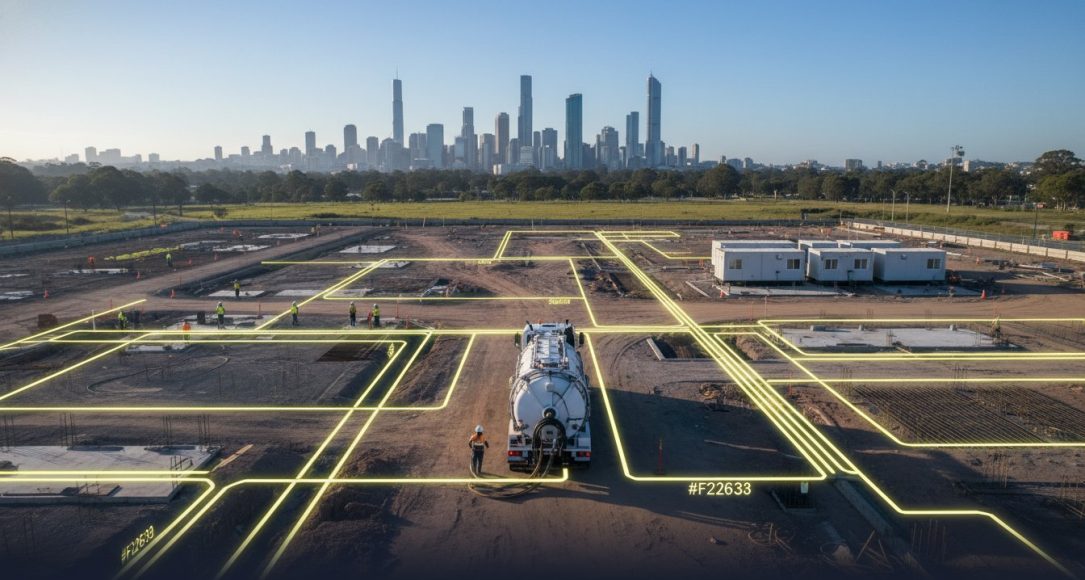
In a market where Brisbane construction costs are escalating by 7.5% this year, the most expensive mistake a developer can make isn’t a design flaw; it’s a single strike against an unmapped utility. You’ve likely experienced the frustration of relying on inaccurate historical records or the mounting pressure of high insurance premiums tied to subsurface uncertainty. It’s a risk that shouldn’t be ignored during the current infrastructure boom. This guide explores how strategic vacuum excavation brisbane services integrate with professional site investigations to eliminate utility strikes and ensure project continuity.
We’ll examine how non-destructive digging achieves Quality Level A accuracy under the AS 5488 standard and aligns with the Excavation Work Code of Practice 2021 to protect your assets and your bottom line. By moving from theoretical mapping to physical certainty, you can secure your project against the delays and liabilities that often derail large-scale developments across South East Queensland. This systematic approach transforms subsurface investigation from a compliance hurdle into a strategic advantage for your next project.
Key Takeaways
- Understand the technical mechanics of high-pressure water and suction that define non-destructive digging as the primary method for safe utility potholing.
- Identify high-stakes applications for vacuum excavation brisbane projects, including the protection of critical fiber-optic networks and heritage sites within the CBD.
- Evaluate the total value of non-destructive methods by weighing direct operational costs against the mitigation of utility strike liabilities and project delays.
- Learn how physical potholing data integrates with engineering surveying to create precise 3D models of subsurface infrastructure for future-ready project planning.
- Establish a framework for selecting a service partner by assessing fleet capabilities and adherence to national safety and certification standards.
What is Vacuum Excavation? Defining Non-Destructive Digging (NDD)
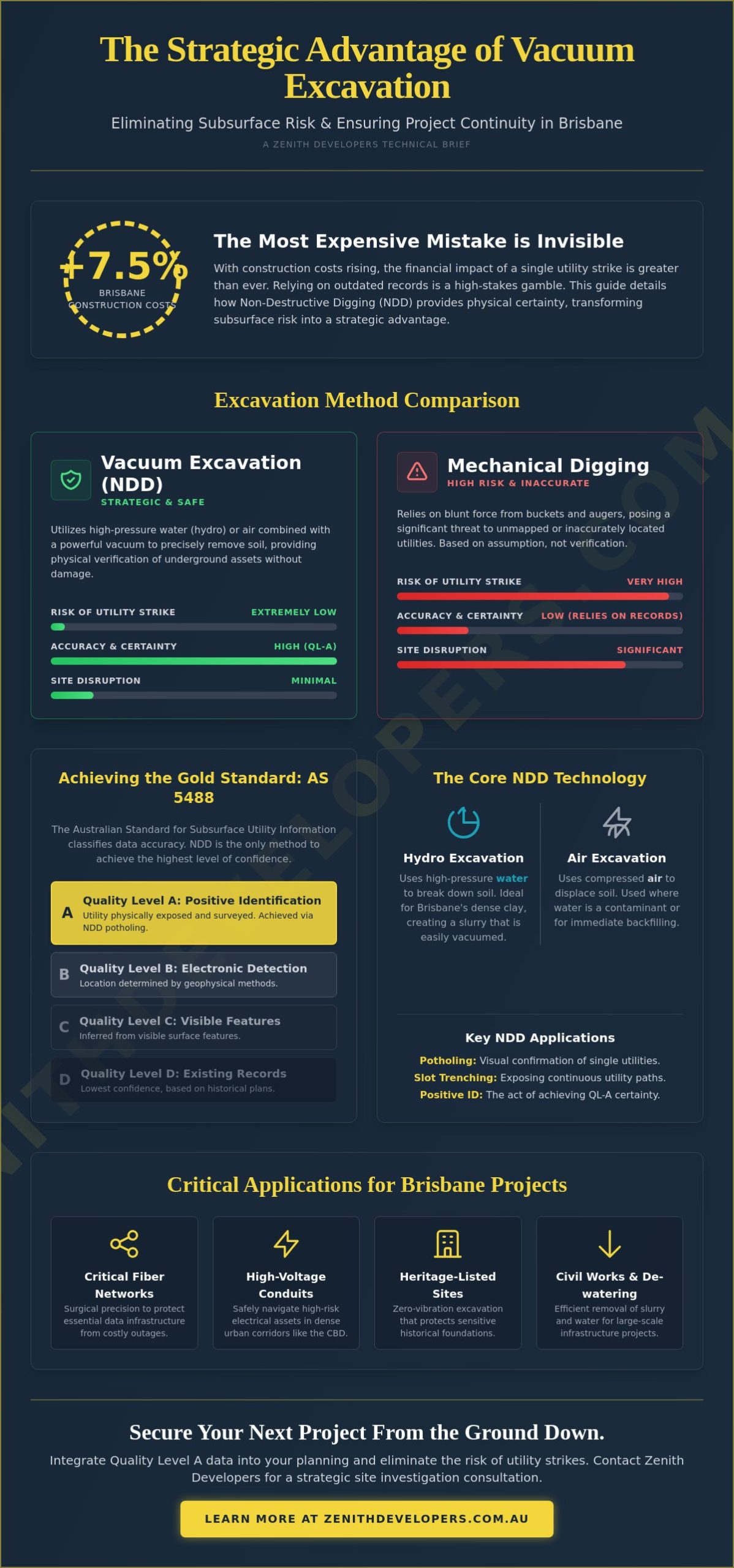
Strategic vacuum excavation brisbane services provide more than just a means to move earth; they represent a fundamental shift toward data-driven site management. At its core, the technology utilizes a suction excavator system that pairs high-pressure mediums with powerful vacuum recovery. This process allows for the removal of soil and debris without the blunt force associated with mechanical buckets or augers. By utilizing kinetic energy rather than mechanical shearing, operators can expose sensitive infrastructure with surgical precision. It’s this characteristic that has earned the process the industry designation of Non-Destructive Digging (NDD).
In Brisbane’s high-density urban corridors, the reliance on traditional mechanical excavation has become a liability. The complexity of modern utility networks means that even the most experienced backhoe operator faces significant risks when working near unverified assets. Vacuum excavation serves as the essential bridge between theoretical records and physical reality. It allows project managers to verify the exact depth, alignment, and condition of utilities before heavy machinery ever touches the ground. This practice, often referred to as ‘potholing’, is now a cornerstone of responsible project commencement across South East Queensland.
The Core Technology: Hydro vs. Air Excavation
The choice of excavation medium is a strategic decision based on geological conditions and project requirements. Hydro excavation is the preferred method for Brisbane’s stubborn clay-based soils. The pressurized water acts as a lubricant, quickly breaking down heavy earth while the vacuum system captures the resulting slurry. When immediate backfilling is a priority or when working in environments where water may be a contaminant, air excavation is utilized. Zenith Developers analyzes site-specific geological data to select the appropriate medium, ensuring that the vacuum excavation brisbane teams deploy the most efficient tool for the specific terrain.
Key Terminology for Site Managers
Effective communication on-site requires a shared understanding of technical terminology. Site managers should be familiar with the following concepts:
- Potholing: The process of digging small, localized holes to visually confirm the location of a utility.
- Slot Trenching: Creating long, narrow excavations to determine the path of a utility or to install new infrastructure in crowded corridors.
- Positive Identification (Pos-Id): The gold standard of utility verification, where the asset is physically exposed and its coordinates are recorded.
- AS 5488-2019: The Australian Standard for the Classification of Subsurface Utility Information, which provides a framework for the accuracy of utility data.
Achieving Quality Level A under AS 5488-2019 requires the physical exposure of the utility. This level of certainty is only possible through NDD. By integrating these precise methodologies into the broader site investigation, we ensure that every subsurface data point is verified and actionable, reducing the likelihood of costly project interruptions.
Critical Applications for Brisbane Infrastructure Projects
Brisbane’s rapid infrastructure expansion demands a surgical approach to excavation, particularly within the densely packed CBD. Here, the presence of high-voltage electrical conduits and critical fiber-optic networks creates a high-stakes environment where traditional digging is often deemed too risky. Strategic vacuum excavation brisbane services provide the necessary precision to navigate these corridors without disrupting essential services. By utilizing targeted potholing, teams can visually confirm the location of assets that may have shifted over decades. This ensures that new installations align perfectly with existing infrastructure without the guesswork that leads to costly repairs.
Beyond the city center, the preservation of Brisbane’s architectural history requires specialized techniques. Safe trenching near heritage-listed sites ensures that foundations remain undisturbed by the vibration and impact of heavy mechanical excavators. This precision extends to smaller-scale requirements, such as digging pier holes or fence posts in areas where the subsurface is a chaotic map of utility lines. For large-scale civil works across South East Queensland, high-volume vacuum systems serve a dual purpose. They facilitate efficient de-watering and slurry removal, keeping sites dry and operational even during the region’s intense weather events.
Utility Locating and Asset Protection
The transition from estimated utility positions to absolute certainty is achieved through the synergy of NDD and underground utility locating Brisbane. This partnership is the only reliable way to verify Class A utility data as defined by Australian standards. Protecting critical water and gas mains during the early works phase isn’t just about safety; it’s about avoiding the catastrophic financial penalties and project delays that follow a major strike. By physically exposing these assets, developers gain the foresight needed to adjust designs in real-time. It’s a proactive strategy that replaces reactive crisis management with planned precision.
Environmental and Urban Benefits
Urban development often clashes with the natural landscape, specifically regarding protected trees under Brisbane City Council jurisdiction. Vacuum excavation allows for the careful exposure of root systems without causing the terminal damage typical of traditional machinery. This method also significantly reduces the physical footprint of the worksite. This is vital when operating in narrow laneways or residential developments where space is at a premium. Because the process is generally quieter and creates less dust, it maintains a cleaner site and fosters better relationships with the surrounding community. For those managing complex sites, engaging a partner for professional underground utility locating Brisbane ensures every environmental and regulatory requirement is met with precision.
Comparing Vacuum Excavation vs. Traditional Mechanical Digging
Choosing between traditional mechanical excavation and non-destructive digging isn’t merely a logistical preference; it’s a strategic decision regarding risk exposure. While a standard backhoe might offer lower hourly operation costs, it lacks the sensory feedback required to detect a 33kV line before contact. The vacuum excavation brisbane specialists provide a surgical alternative that eliminates the blunt-force trauma associated with metal buckets. This precision allows for the creation of “potholes” that are exactly the size required for visual verification, leaving the surrounding soil structure and pavement integrity completely intact. It’s the difference between a broad-scale disruption and a targeted investigation.
In environments where manual hand-digging was once the only safe alternative, vacuum systems increase production rates by a significant margin. This speed doesn’t come at the expense of safety. By removing workers from the direct vicinity of the excavation face and replacing shovels with a pressurized wand, we drastically reduce the risk of personal injury from struck pressurized mains or trench collapses. The ability to dig deep, narrow shafts without expanding the surface footprint makes this technology indispensable for the modern, congested project site.
Risk Management and Insurance Implications
Adopting NDD as a primary site investigation tool significantly lowers the probability of a “Service Strike” incident. This proactive approach is often viewed favorably by insurers, as it demonstrates a commitment to rigorous risk mitigation and can influence project insurance premiums over the long term. Beyond financial protection, this methodology ensures strict legal compliance with the Queensland Work Health and Safety Act 2011. It fulfills the mandatory duty of care to identify and protect underground essential services before work commences, providing a documented trail of professional due diligence that protects both the PCBU and the project’s reputation.
Efficiency in Brisbane Soils
Brisbane’s unique geology, characterized by the abrasive “Brisbane Tuff” and heavy alluvial clays, presents a significant challenge for traditional digging methods. High-pressure hydro units are particularly effective here; they break down dense clay structures that would stall manual labor or potentially damage mechanical equipment. Spoil management is equally streamlined. Because all excavated material is vacuumed directly into a debris tank, urban sites remain compliant with local environmental standards and remarkably tidy. This cleanliness reduces the need for secondary site remediation, allowing the project to move from investigation to construction without the typical mess of stockpiled spoil or runoff issues.
Integrating Vacuum Excavation into the Surveying Lifecycle
Strategic site development relies on the seamless transition from data acquisition to spatial analysis. Integrating vacuum excavation brisbane into the surveying lifecycle transforms a physical hole into a digital asset. This process moves beyond mere digging; it’s a methodical approach to capturing subsurface truth. By treating every pothole as a data point, we bridge the gap between historical records and the actual conditions of the site. This integration ensures that every stakeholder, from the lead engineer to the site foreman, operates from a single, verified source of truth.
The critical link between physical potholing and engineering surveying brisbane can’t be overstated. While locating services provide a horizontal estimate of a utility’s path, survey-accurate potholing provides the precise vertical elevation (Z-coordinate) of an asset. This three-dimensional clarity is essential for gravity-fed systems and complex utility crossings where millimeters matter. It allows for the creation of digital twins that represent the subsurface landscape with absolute fidelity.
From Locating to Mapping
Geophysical methods like Ground Penetrating Radar (GPR) or CCTV pipe inspections identify the presence of a utility, but they often lack the definitive physical proof required for high-precision design. NDD provides that proof. By physically exposing the asset, surveyors can capture precise coordinates that update cadastral records and ensure ‘As-Constructed’ drawings reflect reality rather than outdated design intent. This survey-accurate data is then preserved for future site works, preventing the need for repetitive investigation and reducing long-term operational costs.
Supporting Town Planning and Feasibility
Feasibility studies for major developments often uncover ‘fatal flaws’-such as unmapped high-pressure mains or unexpected rock formations-only after the design phase is locked. Using vacuum excavation brisbane early in the process allows Town Planning teams to identify these constraints during the due diligence phase. This foresight enables more effective negotiation of easements and boundary setbacks, aligning the project with Queensland’s land development regulatory framework from the outset. It ensures that Development Applications (DA) are based on physical certainty, reducing the likelihood of costly design revisions or site-entry delays during the construction phase.
Ensuring your project begins with an accurate subsurface map reduces the need for reactive design changes. To integrate these precision services into your next project, consult with the experts at Zenith Developers for a comprehensive site investigation.
Selecting a Vacuum Excavation Partner in South East Queensland
Identifying the right partner for vacuum excavation brisbane requirements involves looking beyond the physical machinery. While the size of the fleet is a logistical consideration, the technical intelligence behind the operation determines the project’s ultimate success. A professional partner should offer a diverse range of equipment, from compact 4×4 units designed for restricted urban access to high-capacity 10,000L trucks suited for large-scale civil spoil removal. This ensures that the equipment deployed is perfectly matched to the volume of the task and the spatial constraints of the site.
Operational excellence is underpinned by rigorous certification and training. It’s essential to verify that a provider maintains current Before You Dig Australia (BYDA) certification and that their operators possess deep experience in the specific geological conditions of South East Queensland. High-pressure excavation requires a nuanced touch; an undertrained operator can still damage utility sheathing if they don’t respect the technical limits of the equipment. A partner who prioritizes ongoing training ensures that the “non-destructive” promise of NDD is upheld in every pothole and trench.
The Zenith Difference: Precision Meets Strategy
Zenith Developers distinguishes itself by treating vacuum excavation as a sophisticated diagnostic tool rather than a simple digging service. Our background in cadastral and engineering surveying provides a unique perspective that standard truck-hire companies lack. We don’t just expose a pipe; we understand its spatial significance within the broader project lifecycle. This surveying-led approach ensures that every utility located is accurately recorded and integrated into a holistic site investigation package. By combining underground utility locating with concrete scanning and CCTV inspections, we provide a comprehensive subsurface map that serves as a steady foundation for your long-term project goals.
Getting Started with Your Site Investigation
Initiating a professional site investigation begins with a clear scope of work. When requesting a quote for vacuum excavation brisbane, it’s helpful to provide any existing site plans or BYDA records to help our team assess the likely density of the utility network. Before the vacuum truck arrives, ensure that site access is clear and any known surface hazards are identified. This preparation allows our operators to begin the potholing process immediately, maximizing on-site efficiency. For developers seeking to mitigate risk and ensure regulatory compliance, our Brisbane-based team is available to provide strategic advice on the most effective investigation methodology for your specific land parcel. Contact us to discuss how our integrated surveying and excavation services can protect your assets and maintain your project’s momentum.
Securing Subsurface Certainty for Future-Ready Infrastructure
The evolution of Brisbane’s urban landscape requires a transition from reactive digging to proactive, data-driven site management. By integrating vacuum excavation brisbane with professional surveying, project managers move beyond the limitations of historical records to achieve absolute physical certainty. This methodical approach doesn’t just prevent utility strikes; it provides the high-fidelity data necessary to navigate the complex regulatory and physical requirements of modern infrastructure development. It’s about aligning technical execution with a long-term strategic vision that prioritizes safety and precision.
Zenith Developers has been serving Brisbane and South East Queensland since 2015, providing a steady hand for developers who prioritize quality and responsible growth. Our BYDA Certified Locators and integrated surveying and planning expertise ensure that every subsurface investigation is both comprehensive and compliant with the highest industry standards. We invite you to leverage our intellectual preparation and technical proficiency to safeguard your next project from the hidden risks of the underground landscape.
Secure Your Site with Zenith’s Strategic Vacuum Excavation Services
We look forward to partnering with you to ensure your project’s continuity and long-term success through precision and foresight.
Frequently Asked Questions
What is the average cost of vacuum excavation in Brisbane?
Operational costs for vacuum excavation brisbane services are typically influenced by the specific volume of the debris tank and the complexity of the waste disposal requirements. While industry rates across Australia often reflect the specialized nature of the equipment, project managers should prioritize value over hourly rates to account for efficiency gains. We recommend requesting a comprehensive quote that includes mobilization and disposal fees to ensure a transparent understanding of the total investment required for your site investigation.
Is hydro excavation safe for all types of underground utilities?
Hydro excavation is considered the safest methodology for exposing the full spectrum of underground assets, including high-voltage electrical conduits, gas mains, and sensitive fiber-optic networks. The ability to modulate water pressure allows operators to break through dense soil without compromising the integrity of utility sheathing or protective coatings. This precision makes it the preferred choice for achieving Quality Level A data under Australian Standard AS 5488, providing a level of security that mechanical digging cannot replicate.
How deep can a vacuum truck excavate?
Most modern vacuum trucks are capable of excavating to depths of 10 to 15 metres, though this depends heavily on the soil density and the vertical lift capacity of the vacuum pump. For deeper requirements, specialized high-volume units are utilized to maintain suction efficiency over extended distances. This capability allows for the precise investigation of deep-set sewer and stormwater infrastructure that would otherwise require extensive and high-risk trenching with traditional earthmoving equipment.
Do I still need a Dial Before You Dig (BYDA) report if I use vacuum excavation?
Obtaining a BYDA report remains a mandatory legal requirement under the Queensland Work Health and Safety Act 2011 regardless of the excavation method used. These records provide the necessary starting point for any subsurface investigation by identifying the likely presence of essential services. Vacuum excavation then serves as the critical verification step, transforming the indicative data from the BYDA report into the physical certainty required for safe and compliant site works.
What happens to the waste material (slurry) collected by the truck?
The slurry and soil captured during the process are vacuumed directly into a sealed debris tank for secure transport to a licensed waste disposal facility. This systematic approach ensures that urban sites remain clean and compliant with Brisbane City Council environmental regulations regarding runoff and spoil management. By removing the waste immediately, project managers eliminate the need for on-site stockpiling and secondary remediation, which streamlines the transition from investigation to construction.
Can vacuum excavation be used in narrow or restricted access areas in the Brisbane CBD?
Strategic vacuum excavation brisbane services utilize a range of equipment, including compact 4×4 units designed specifically for the restricted access common in the CBD and narrow laneways. When the truck cannot be positioned directly adjacent to the dig site, long-reach hoses are deployed to bridge the distance without losing suction power. This flexibility allows for precise utility verification in congested urban environments where traditional machinery would be physically unable to operate safely or effectively.
How does vacuum excavation protect tree roots on development sites?
Vacuum excavation protects tree roots by utilizing pressurized water or air to gently displace soil from around the root system without causing mechanical damage. Unlike the blunt force of an excavator bucket, which can sever critical roots and lead to tree instability, NDD leaves the root structure intact for inspection or relocation. This methodology is essential for maintaining compliance with vegetation protection orders and ensuring the long-term health of protected trees on development sites.
What is the difference between hydro excavation and traditional potholing?
Hydro excavation is the technical methodology used to move earth, while potholing is the specific application of that method to visually confirm a utility’s location. Traditional potholing was often performed through slow and labor-intensive manual hand-digging, which carries a higher risk of accidental tool strikes. Modern hydro excavation has transformed this process into a systematic, high-speed investigation that provides the same visual confirmation with significantly greater precision and safety for the operator and the asset.