
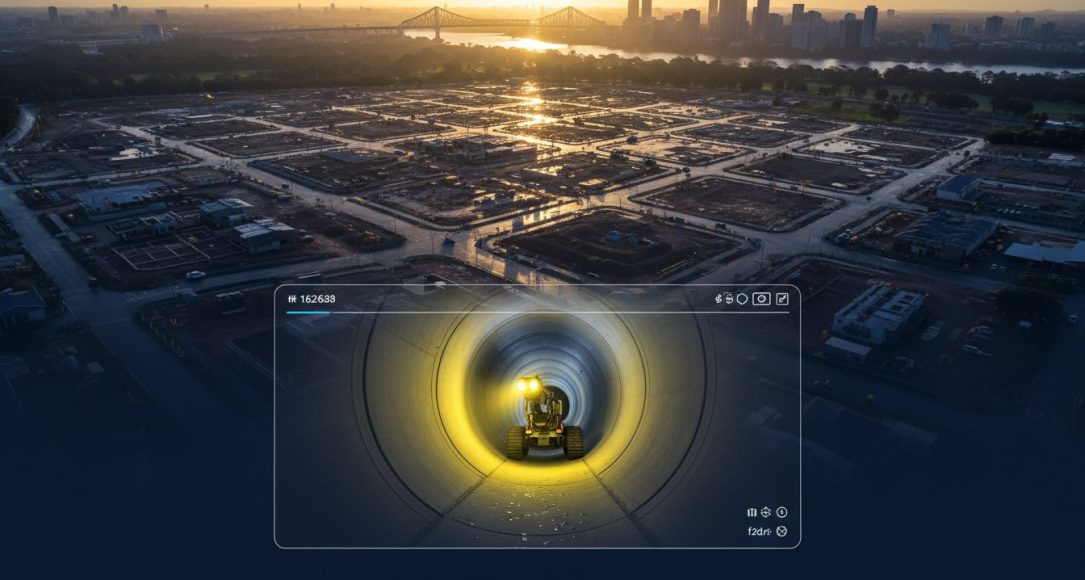
A single undetected hairline fracture in a stormwater main can derail a multi-million dollar development schedule before the first excavator even arrives on site. For developers across Queensland, the strategic question isn’t just about what is cctv pipe inspection but how this data-driven process secures project timelines against unforeseen underground failures. You likely recognize that subsurface uncertainty is the primary driver of budget blowouts and delayed Council DA approvals. Relying on outdated site maps or guesswork is no longer a viable strategy for high-stakes infrastructure projects.
This guide explores how advanced diagnostic technology identifies hidden pipeline risks and ensures total compliance with the WSA 05-2020 Version 4.1 national standard. We’ll examine the technical methodologies that provide clear visual proof of pipe conditions, helping you mitigate risk long before excavation begins. By integrating these precise insights into your site investigation, you can satisfy stringent local council requirements and maintain the momentum of your Queensland construction project with absolute confidence.
Key Takeaways
- Understand the core methodology of what is cctv pipe inspection and how high-definition robotic crawlers facilitate a non-destructive assessment of subsurface structural integrity.
- Discover how precision visual data reduces project overheads by eliminating the need for exploratory excavation and identifying specific fault locations before construction begins.
- Navigate Queensland’s regulatory landscape with insights into the WSA 05-2020 standard and the specific coding requirements necessary for successful council asset handovers.
- Learn how integrating CCTV data with engineering and cadastral surveying creates a comprehensive site map that mitigates risk and ensures long-term project compliance.
- Identify the critical differences between robotic crawlers and push rod cameras to ensure your site investigation utilizes the most effective technology for your specific pipeline dimensions.
Defining CCTV Pipe Inspection in Modern Civil Works
Understanding what is cctv pipe inspection starts with recognizing its role as a high-precision diagnostic tool within the broader framework of Subsurface Utility Engineering (SUE). At its core, this process utilizes specialized robotic cameras to traverse underground networks, providing a clear visual record of assets that are otherwise inaccessible. It’s a non-destructive methodology that allows project managers to assess structural integrity and identify specific faults, such as hairline fractures, root intrusions, or alignment shifts, without moving a single cubic metre of soil. By integrating this data early in the lifecycle, developers can transform underground uncertainty into a manageable variable.
For a strategic developer, knowing what is cctv pipe inspection means viewing it as a risk-mitigation strategy rather than a simple maintenance task. The precision of these surveys ensures that every decision, from foundation design to utility relocation, is based on the current physical state of the infrastructure. This systematic approach eliminates the reliance on “as-built” plans that may no longer reflect the reality of the site, providing a definitive single point of truth for all stakeholders involved in the project.
The Evolution from Basic Plumbing to Asset Management
The industry has moved far beyond the era of simple video feeds. While residential CCTV drain cameras are common for clearing domestic blockages, industrial civil works require a higher tier of data precision. Modern professional-grade units feature high-definition digital recording, 360-degree pan-and-tilt capabilities, and integrated GPS synchronization. This evolution allows for the creation of georeferenced asset maps where every defect is tagged with exact coordinates. This data is no longer just a video file; it’s a strategic asset used for long-term infrastructure planning and complex risk assessments across Queensland’s expanding urban corridors.
When is a CCTV Survey Mandatory in Queensland?
Regulatory alignment is a critical driver for subsurface inspections in the Queensland market. Under the Plumbing and Drainage Regulation 2019, specific triggers necessitate professional CCTV surveys to ensure public safety and asset longevity. These include:
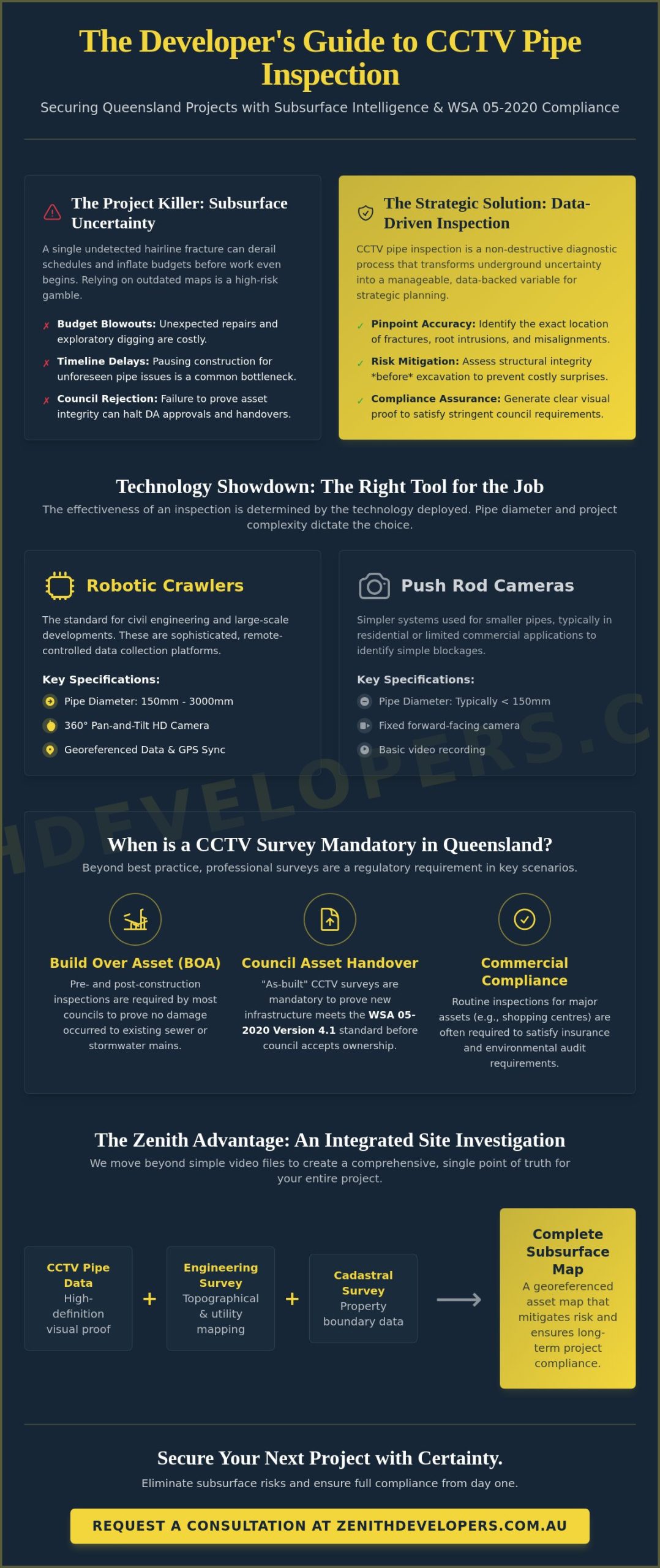
- Build Over Asset (BOA) Applications: Most councils, including Brisbane and Mackay, require pre-construction and post-construction inspections when building near or over existing sewer or stormwater mains to ensure no damage occurs during the build.
- Council Handover: For new developments, “as-built” CCTV surveys are mandatory to prove that the new infrastructure meets the WSA 05-2020 Version 4.1 national standard before the council accepts ownership.
- Commercial Compliance: Major commercial assets and shopping centres often require routine inspections to maintain operational integrity and satisfy insurance or environmental audit requirements.
The Technology Behind Subsurface Visual Inspections
The technical efficacy of a site investigation depends entirely on the caliber of the hardware deployed. When evaluating what is cctv pipe inspection in a professional development context, the answer lies in the integration of high-definition optics and remote-controlled robotics. These systems aren’t merely cameras; they’re sophisticated data-collection platforms capable of navigating high-flow environments and hazardous atmospheres. By utilizing 360-degree pan-and-tilt capabilities, these units allow for a meticulous examination of pipe joints and lateral connections, ensuring that no structural anomaly is overlooked during the survey process.
Strategic asset management requires more than just a video feed. It demands a georeferenced record of the underground environment. Modern systems synchronize visual data with precise distance counters and orientation sensors to create a comprehensive digital profile of the network. This level of detail is essential for developers who need to understand what is cctv pipe inspection as a tool for long-term infrastructure stability rather than a reactive fix for a current blockage.
Robotic Crawlers vs. Push Cameras
The choice between a robotic crawler and a push camera is dictated by pipe diameter and the complexity of the network. For large-diameter mains, typically ranging from 150mm up to 3000mm, remote-controlled robotic crawlers provide the necessary torque and stability to navigate long distances. These units are often NASSCO PACP certified, ensuring that the data captured meets international standards for defect coding. In contrast, push rods are indispensable for smaller lateral lines or domestic junctions where flexibility is paramount. While a push rod excels in tight bends, a robotic crawler can travel up to 300 metres from a single access point, significantly reducing the time spent on site.
Sonde Technology and Precision Mapping
Visual footage alone is insufficient for a truly compliant site plan. To bridge the gap between underground reality and the surface map, we utilize sonde technology. A sonde is a radio transmitter integrated into the camera head that emits a 512Hz signal. This allows our technicians to use a surface locator to mark the exact depth and dead-centre of a detected fault. By integrating this positioning data with underground utility locating and engineering surveying, we create a multi-layered digital twin of your site. This ensures that when your excavation team arrives, they’re working with a plan that reflects real-world conditions with absolute accuracy.
CCTV vs. Traditional Excavation: A Strategic Comparison
Choosing between digital insight and physical intervention represents a defining moment for any commercial project manager. While traditional methods rely on exploratory trenching or “potholing” to find assets, understanding what is cctv pipe inspection allows for a far more surgical approach. By deploying high-resolution optics into the network, we eliminate the need for destructive investigation. This methodology reduces project overheads by pinpointing fault locations before a single shovel enters the ground. It also offers significant environmental benefits, as minimal surface disruption means less waste and a smaller site footprint during the investigation phase.
The safety implications of this digital-first approach can’t be overstated. Traditional excavation carries an inherent risk of utility strikes, even when conducted with care. A visual assessment provides a zero-risk environment for the initial diagnostic phase, allowing the project team to gather critical intelligence without the liability of physical contact with live services. This strategic foresight ensures that when physical work eventually begins, it’s guided by a precise map rather than optimistic guesswork.
Mitigating the Risk of Utility Strikes
Reliance on Dial Before You Dig (DBYD) plans is a common pitfall in site planning. These records are often indicative rather than absolute, and they frequently fail to account for aging or brittle assets that have degraded over decades. Professional surveys provide the “ground truth” that static plans lack. We’ve encountered scenarios where DBYD indicated an active, high-capacity line, but a survey revealed a collapsed pipe that had been non-functional for years. Verifying the condition of these assets before nearby construction begins prevents catastrophic failures and ensures that your project remains compliant with Queensland’s safety regulations.
Cost-Effectiveness in the Development Lifecycle
From a financial perspective, the investment in a comprehensive survey is a fraction of the cost associated with an emergency pipe repair or a total project stoppage. When you consider what is cctv pipe inspection in the context of development feasibility, it becomes a powerful negotiation tool. Identifying structural defects during the due diligence phase allows developers to factor repair costs into site acquisition or adjust foundation designs before they become budget-breaking issues. This proactive data gathering prevents the “hidden surprises” that typically lead to litigation or significant delays during the critical construction phase, ultimately protecting the project’s bottom line and long-term viability.
Navigating QLD Compliance: WSA 05 and Council Standards
Regulatory alignment in Queensland’s development sector is governed by the Water Services Association of Australia (WSAA), which maintains the national standard for conduit assessment. Specifically, the current active version is WSA 05-2020 Version 4.1. For developers, understanding what is cctv pipe inspection in this context means recognizing it as a mandatory data-gathering phase for asset handover. South East Queensland (SEQ) councils, including Brisbane City Council and Unitywater, demand precise defect coding before they’ll accept ownership of any new or modified infrastructure. With a newer version, WSA 05:2025 Version 4.2, scheduled for release in December 2025, maintaining a forward-looking approach to compliance is essential for long-term project viability.
The “Build Over Asset” (BOA) process is another critical area where visual data is non-negotiable. Whether you’re working within the jurisdiction of Unitywater or Queensland Urban Utilities (QUU), providing a compliant report ensures your project avoids the delays associated with rejected submissions. By utilizing industry-standard WinCan reporting software, we ensure that the data captured on-site is fully compatible with council databases, providing a seamless transition from site investigation to official approval.
What is a WSA 05 Coded Report?
A WSA 05 coded report is a standardized technical language used to describe the exact condition of a pipeline. It replaces vague descriptions with specific codes for defects like circumferential cracks, root intrusions, or infiltration. Non-coded reports are frequently rejected by Queensland authorities because they lack the data integrity required for asset management. When we define what is cctv pipe inspection for a professional developer, we’re describing a process where certified operators interpret the subsurface environment with intellectual rigor, ensuring that every observation is accurately tagged and georeferenced.
Steps to a Council-Approved Submission
Securing council approval requires a methodical, four-step progression to ensure the data meets the highest regulatory threshold:
- Step 1: High-pressure cleaning: The line must be cleared of debris and silt to ensure the camera has 100% visibility of the pipe wall.
- Step 2: Systematic survey: A technician conducts the survey following strict WSA 05 protocols, ensuring no sections are overlooked.
- Step 3: Defect coding: A qualified coder processes the HD footage, identifying and tagging every structural or service anomaly.
- Step 4: Digital submission: The completed WinCan report and digital footage are submitted to the relevant authority for final review.
Ensuring your project adheres to these rigorous standards is a fundamental step in risk mitigation. If you are preparing a submission for an SEQ council, you can rely on our expertise to provide a compliant cctv pipe inspection that satisfies all regulatory requirements and keeps your development on track.
The Zenith Advantage: Integrated Site Investigation
Zenith Developers approaches site investigation with an intellectual rigor that transcends simple utility locating. While many providers treat subsurface imaging as an isolated task, we view it as a critical data stream that must be perfectly synchronized with cadastral surveying and engineering surveying. This methodology allows us to provide a single point of truth for your project, where underground asset data and property boundaries exist in a unified, georeferenced environment. By choosing a partner that understands the strategic intersection of these disciplines, you ensure that your project moves from the initial site investigation to DA approval with a foundation of absolute accuracy.
Our Queensland-based team brings a deep understanding of local regulatory nuances, ensuring that the data we capture is immediately actionable for your design and construction teams. This isn’t just about providing a video file; it’s about delivering a professional consultancy that anticipates the complexities of large-scale developments. We facilitate active management of your underground assets, transforming technical footage into a strategic roadmap for your project’s success.
Combining CCTV with Vacuum Excavation
There are instances where visual data alone is insufficient for high-risk construction activities. In these scenarios, we integrate our camera surveys with vacuum excavation, also known as non-destructive digging (NDD). When a survey identifies a critical blockage or a high-priority asset in a congested corridor, vacuum excavation allows for the safe, physical verification of that asset without the risk of mechanical damage. Utilizing precise hydro-jetting to clear obstructions identified by the camera ensures that the pipeline is not only inspected but also restored to its optimal functional state, protecting the longevity of the infrastructure while maintaining project momentum.
Holistic Data for Town Planning and Design
The real value of understanding what is cctv pipe inspection lies in how that data informs town planning and infrastructure design. Accurate information regarding pipe depths, material condition, and exact alignment allows planners to optimize site layouts and foundation designs long before construction begins. This foresight prevents the costly redesigns that occur when “unexpected” underground conditions are discovered mid-build. By ensuring that your infrastructure design accounts for real-world subsurface data, you mitigate the risk of structural interference and ensure long-term compliance with council standards. To secure the future of your next Queensland development, contact Zenith Developers for a comprehensive site investigation proposal.
Securing Your Development’s Subsurface Future
Successfully navigating the complexities of Queensland’s infrastructure landscape requires more than just a camera down a drain. It demands a strategic integration of visual diagnostics and surveying precision to ensure every underground asset is accounted for before construction begins. By now, you recognize that what is cctv pipe inspection serves as a vital risk-mitigation tool, replacing destructive excavation with high-definition digital certainty. Aligning your project with the WSA 05-2020 Version 4.1 standard isn’t just a regulatory hurdle; it’s a commitment to the long-term integrity of your development’s subsurface assets.
Zenith Developers provides the intellectual preparation and technical proficiency needed to move your project from a preliminary site investigation to a successful council handover. As a Queensland owned and operated firm since 2015, we combine WSA 05 accredited reporting with integrated surveying and utility locating expertise to deliver a single, reliable point of truth. We’re ready to help you transform underground uncertainty into a clear roadmap for success.
Secure your site with a professional CCTV pipe inspection from Zenith Developers and maintain the momentum your project deserves.
Frequently Asked Questions
How much does a CCTV pipe inspection cost in Brisbane?
Costs vary based on the project’s technical scope, including the total linear metres of the network and the level of debris present. While basic residential surveys are relatively straightforward, commercial development sites require detailed WSA 05 coding and potentially high-pressure cleaning to ensure visibility. Factors such as site accessibility and the diameter of the assets also influence the final investment required for a compliant survey.
Will a CCTV report from Zenith satisfy Unitywater or QUU requirements?
Our reports are specifically designed to meet the stringent requirements of Unitywater, Queensland Urban Utilities (QUU), and local councils. By utilizing WSA 05-2020 Version 4.1 standards and WinCan reporting software, we ensure that every defect is coded correctly for asset handover. This precision is essential for developers who need to understand what is cctv pipe inspection as a gateway to successful DA approvals.
How long does it take to perform a CCTV survey on a standard development site?
A standard residential inspection typically takes between 30 and 60 minutes, whereas larger commercial development sites depend on the total length of the network. Complex industrial surveys may require a full day or more, particularly if robotic crawlers need to travel several hundred metres from a single access point. We prioritize methodical data collection to ensure the structural integrity of the entire system is documented.
Can CCTV cameras find leaks in underground pipes?
CCTV technology identifies visual evidence of leaks, such as groundwater infiltration through joints or visible fractures in the pipe wall. While the camera doesn’t use acoustic sensors, it provides the clear visual proof needed to diagnose the source of subsurface water loss. This visual data is a fundamental component of subsurface utility engineering, allowing for targeted repairs rather than the broad, expensive excavation often associated with underground failures.
What pipe sizes can your CCTV robotic crawlers inspect?
Our specialized robotic crawlers and push cameras are capable of inspecting pipes ranging from 50mm up to 3 metres in diameter. This versatility allows us to survey everything from small domestic lateral lines to massive stormwater trunk mains. We select the appropriate hardware based on the internal diameter and flow conditions to ensure the camera remains stable and provides high-definition footage throughout the entire length of the conduit.
Is it necessary to clean the pipes before a CCTV inspection?
High-pressure cleaning is often mandatory to ensure the camera can clearly see the pipe’s internal surface and any structural defects. Silt, grease, and debris can obscure hairline cracks or root intrusions, which may lead to a rejected council submission. By performing a thorough clean prior to the survey, we ensure the final report meets the rigorous visibility requirements set by the WSA 05 national code.
What is the difference between a ‘Build Over Sewer’ and a standard CCTV survey?
A ‘Build Over Asset’ (BOA) survey typically involves both a pre-construction and a post-construction inspection to prove that building activities haven’t damaged the utility. A standard survey is often a one-off diagnostic tool for maintenance or site investigation. For developers, knowing what is cctv pipe inspection in a BOA context is critical for satisfying the specific indemnity requirements of Queensland water authorities.
Do I get a copy of the video footage and the written report?
You receive a comprehensive digital package that includes the high-definition video footage and a detailed, coded PDF report. The report identifies every defect with georeferenced locations and severity ratings according to national standards. This documentation provides the ground truth needed for engineering design, town planning submissions, and long-term asset management, ensuring you have a permanent record of the site’s subsurface conditions.